Any Right We Give Away, We Give Away for Good

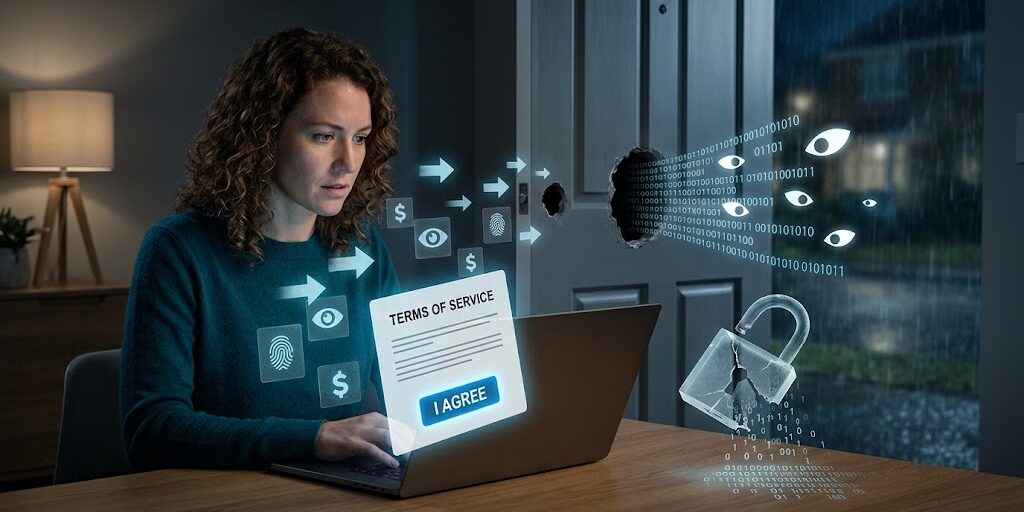
Imagine you just bought a beautiful new house. The house has strong walls, bright windows, and a heavy wooden front door. That front door has a shiny lock on it. That lock is your privacy. It keeps you safe. It decides who gets to come inside and who has to stay out.
One day, a company comes to your house. They say, “If you take the lock off your door and let us look inside whenever we want, we will give you a free TV.”
You think about it. You really want that free TV. So, you take the lock off. You throw it in the trash. The company comes in, looks around your living room, and gives you the TV. You sit down to watch a show, feeling happy.
But the next day, a stranger walks into your house. Then another. Then five more. They walk through your kitchen. They look in your bedroom. You shout, “Get out! I only said the TV company could come in!”
But it is too late. You threw the lock away. The door is wide open. And once the lock is gone, anyone can come inside. You cannot find the lock in the trash anymore. The right to keep people out of your house is gone forever.
This is exactly what happens when we use the internet today. When it comes to your personal information, any right we give away, we give away for good.
What Does “Giving Away a Right” Mean?
In the real world, rights are very clear. You have the right to be quiet. You have the right to vote. You have the right to close your curtains so people cannot see you eat dinner.
But on the internet, rights are confusing. We give them away without even knowing it. We do it by clicking small buttons that say “I Agree.” We do it to play a free game. We do it to read a news story. But every time we click that button, we are throwing away the lock on our front door.
The “Terms of Service” Trap
Have you ever signed up for a new social media app? Before you can look at pictures of your friends, a big box of text pops up. It is called the “Terms of Service.” It is usually fifty pages long. The words are huge and complicated. Lawyers write these words to confuse normal people.
Nobody reads the whole thing. We just scroll to the very bottom and click “I Agree.” But what did you just agree to?
Usually, you just agreed to give away your right to privacy. You agreed that the app can read your text messages. You agreed that the app can track where you drive your car. You gave them the right to know your life. Once you click that button, you can never take it back. That is understanding how data sharing works.
Real-Life Example: The Flashlight App
Let’s look at a real-life example of giving away rights. A few years ago, before cell phones had built-in flashlights, millions of people downloaded free “Flashlight Apps” from the app store.
The app did one simple thing: it turned the light on the back of the phone on and off. It was very helpful in the dark.
But when people downloaded the app, a little box popped up. It said, “This app needs permission to access your Contacts, your Microphone, and your GPS Location.”
Why Does a Lightbulb Need to Hear You?
People were in a hurry. They wanted the flashlight to work. So, they clicked “Allow.” They gave away their rights.
Why would a flashlight need to know where you are standing? Why does a flashlight need to know the phone numbers of your friends? It doesn’t.
The company that made the app was not a flashlight company. They were a data company. They used the app to secretly track millions of people. They recorded where people went to work. They copied their address books. Then, they sold all of this information to advertisers and data brokers.
Even if those people deleted the flashlight app the very next day, it was too late. The company already had their data. They already sold it. The lock was off the door. That right to privacy was gone for good.
The Big Myth: “I Have Nothing to Hide”
When you talk to people about digital privacy, many of them will say the same thing. They will say, “I do not care if companies track me. I am a boring person. I have nothing to hide.”
This is the most dangerous myth in the world. It is the reason we give our rights away so easily.
“Arguing that you don’t care about the right to privacy because you have nothing to hide is no different than saying you don’t care about free speech because you have nothing to say.”
You might not have anything illegal or bad to hide. But you still have a life to protect. Privacy is not about hiding bad things. Privacy is about keeping your normal life safe from strangers.
Scenario: The Window Blinds
Imagine you are sitting in your living room watching a boring TV show. You are eating a bowl of cereal. You are doing nothing wrong. You have nothing to hide.
Suddenly, a stranger walks up to your living room window and presses his face against the glass. He stares at you while you eat. He writes down what kind of cereal you are eating. He writes down what TV show you are watching.
What do you do? You close the window blinds! You pull the curtains shut.
You did not close the blinds because you were doing something bad. You closed the blinds because the stranger was being creepy. You closed the blinds because your living room belongs to you, not him. You have the right to eat cereal in peace.
On the internet, there are millions of strangers looking through your windows. When you say, “I have nothing to hide,” you are taking the blinds off your windows and letting everyone watch you forever.
Real-Life Example: The Face Scanner
Let’s look at another real-life example. This one is about pictures. Almost everyone likes to share pictures online. We share pictures of our vacations, our pets, and our faces. We do it to show our friends.
But a few years ago, a company called Clearview AI did something terrifying. They built a powerful computer program. This program crawled across the entire internet. It went to Facebook, Instagram, Twitter, and professional websites.
The program copied every single picture of a human face it could find. It scraped billions and billions of photos. Then, it connected those faces to the people’s real names.
The Loss of Public Anonymity
Now, this company has a massive search engine for faces. They sell access to this search engine to police, wealthy companies, and rich individuals.
Imagine you are walking down the street, buying a coffee. A stranger takes a picture of you with their phone. They put that picture into the Clearview app. Instantly, the app tells the stranger your full name, where you work, and links to your social media.
When we uploaded all those pictures, we thought we were just sharing with friends. But really, we were giving away our right to be anonymous in public. We gave away our right to walk down the street without a name tag on our foreheads. And because our faces are already in their system, we can never get that right back. You cannot change your face.
This is a prime example of what your digital footprints can reveal about you without your permission.
Scenario: The Smart Home Spies
Let’s look at a scenario that happens in millions of homes right now. Technology is amazing. We have “smart” devices everywhere. We have smart TVs, smart speakers, and smart refrigerators.
You buy a smart speaker. You put it on your kitchen counter. You use it to play music and set timers for baking cookies. It is very fun and very easy to use.
But to work, the smart speaker has to be listening all the time. It has to listen for its “wake word.” This means there is a live microphone in your kitchen, listening to your family eat dinner. Listening to you argue with your spouse. Listening to you talk about your money problems.
The Right to a Quiet Home
When you plugged that speaker in, you agreed to the terms of service. You gave the company the right to record your voice. You gave them the right to save those recordings on their giant computers far away.
Maybe the company promises they will never listen to the recordings. But what if the company gets hacked by bad guys? What if the company goes out of business and sells all its computers to someone else?
The recordings of your private family moments are out of your house. They are gone. You gave away the right to a truly private kitchen. If you want to understand how deep this goes, you can read our deep dive into how smart homes are huge data mines.
Why Can’t We Just Take Our Rights Back?
In the real world, if you make a mistake, you can usually fix it. If you lend a book to a friend, you can ask for it back. If you leave the door open, you can walk over and shut it.
So why can’t we just take our data back on the internet?
The problem is that digital data is not like a book. Digital data is weightless. It takes zero seconds to copy. It costs zero dollars to copy.
The Copy Machine Effect
Imagine you write a secret on a piece of paper. You hand that paper to a company. You say, “Please keep this safe.”
Instead of keeping it safe, the company puts the paper in a copy machine. They make one thousand copies. Then, they hand those copies out to one thousand data brokers.
Then, those one thousand data brokers make one thousand copies each. Now there are one million copies of your secret floating around the world.
You can go back to the first company and say, “Give me my paper back!” They might hand you the original piece of paper. But it does not matter. There are still one million copies out there. The internet is the ultimate copy machine. Once you give your data away, it multiplies like a virus.
Real-Life Example: The DNA Test Kits
One of the scariest examples of giving away rights involves our actual biology: our DNA.
A few years ago, sending your DNA to a company became a fun trend. People paid money to spit in a plastic tube and mail it in the post office. A few weeks later, the company would send them an email saying, “You are 50% Irish and 50% Italian!”
It was fun. People shared the results on social media.
The Hidden Cost of Spitting in a Tube
But people did not read the fine print. By sending in their spit, they gave these companies the right to keep their DNA code forever. DNA is the most private thing in the world. It is the blueprint of your entire body. It tells doctors what diseases you might get. It tells scientists who your family is.
Years later, police departments started asking these DNA companies for access to their databases. In some cases, the companies gave it to them. Suddenly, people’s fun family history tests were being used by the government to track down suspects.
Worse, pharmaceutical companies bought the rights to study the DNA data to make new medicines. The people who spit in the tubes did not get any money for this. They just gave away the blueprint of their body for a fun email.
You can delete your email account. You can change your phone number. You can even change your home address. But you can never change your DNA. The people who mailed those tubes gave away the ultimate privacy right for good.
What Happens to Our Children?
Giving away our rights does not just hurt us. It hurts the next generation. It hurts our children.
Children growing up today have never known a world without the internet. They have never known a world without tracking. From the day they are born, their parents post pictures of them online. When they go to school, they use smart tablets that track how fast they read.
Forgetting What Privacy Looks Like
If we continue to give away our rights, our children will not even know what privacy is. They will think it is completely normal for a TV to listen to them. They will think it is normal for strangers to know where they live.
If you don’t know you have a right, you will not fight for it. By clicking “I Agree” today, we are stealing the idea of freedom from our kids tomorrow. If you want to protect your family, you must learn how to keep your family’s digital privacy safe.
How We Lose Rights One Tiny Step at a Time
No one wakes up in the morning and says, “I am going to give away all my freedom today!” We lose our rights in tiny, tiny pieces. It happens so slowly that we do not even notice it.
It is like the story of the boiling frog. If you drop a frog in a pot of boiling water, it will jump right out because it hurts. But if you put a frog in cold water and turn the heat up very, very slowly, the frog will stay in the pot. It gets used to the warmth. It doesn’t realize it is cooking until it is too late.
We are the frogs. Ten years ago, if a company asked to put a microphone in our bedroom, we would have screamed “No!” But they didn’t ask that. First, they gave us a smart phone. Then they gave us a fun app. Then they gave us a smart speaker. They turned the heat up slowly. Now, we are boiling in a pot of surveillance, and most people think it feels fine.
How to Stop Giving Away Your Rights
The story sounds scary. And it is. But you are not helpless. You can stop giving away your rights today. You just have to be strong. You have to be smart. You have to guard your front door.
Here are the steps you must take to protect your digital life.
Step 1: Read Before You Click
You do not have to read all fifty pages of a legal document. But you must pay attention. When an app asks for permission to use your camera, stop and think. Does a calculator app need your camera? No. Click “Deny.”
Guard your permissions like they are gold coins. Only give them to apps that absolutely need them to work.
Step 2: Say No to Sharing
Stop oversharing on social media. You do not need to check-in to every restaurant you visit. You do not need to post a picture of the front of your house. If you must share, make your accounts private. Make sure only your real friends can see what you post.
Remember, if an app or service is completely free, you are not the customer. You are the product being sold. That is why if it’s free, you are the product.
Step 3: Delete What Is Already Out There
Stopping new tracking is important. But what about all the times you already clicked “I Agree”? What about the data the data brokers already copied a million times?
You cannot change the past, but you can clean it up. The law says you have the right to demand that data brokers delete your files. They must take your name, your address, and your family’s information off their websites.
The Hard Way
You can do this yourself. You have to search for your name on Google. You have to find all 150 data broker websites. You have to email them, call them, and mail them letters demanding they erase you. It takes hundreds of hours. It is frustrating. It is exhausting.
The Smart Way: Let Wiperts Do It
Because the process is so hard, companies like Wiperts.com were created to help normal people fight back. Wiperts is a professional privacy team.
When you hire Wiperts, we do the fighting for you. We use our software and our experts to hunt down your data across the internet. We contact the data brokers. We force them to delete your files. We clean up your past.
And because data brokers are sneaky and try to put your data back online later, Wiperts never stops. We monitor the web constantly. If your name pops up again, we strike it down again. We act as the new, unbreakable lock on your front door. If you are serious about your safety, check out our guide to understanding online privacy protection.
Conclusion: Hold On to Your Freedom
Your privacy is not just a digital setting on your phone. Your privacy is a fundamental human right. It is the right to be left alone. It is the right to be safe. It is the right to control who gets to know your deepest secrets.
Every time we click “I Agree” without thinking, we throw away a little piece of that freedom. The internet makes it very easy to give rights away, and almost impossible to get them back.
Do not let companies bribe you with free apps and funny quizzes. Your personal data is worth much more than a free flashlight on your phone.
Start paying attention today. Guard your data. Delete the files that are already out there. Put the lock back on your front door. Because any right we give away today, we give away for good.
Don’t let data brokers sell your secrets.
Wiperts finds and removes your private information from the internet automatically. Regain your peace of mind today.
Protect My Identity Now