Privacy is Awesome: The Superpower You Didn’t Know You Had

Privacy isn’t about hiding in the dark. It’s about dancing in the light, completely free.
Let’s talk about singing in the shower.
Almost everyone does it. You grab the soap, the warm water hits your back, and suddenly you are a rock star. You sing off-key, you hit the high notes terribly, and you dance around. It feels incredibly good. It feels freeing.
Now, imagine singing that exact same way, but there is a transparent glass wall in your bathroom, and fifty strangers are standing in your hallway taking notes on your performance. Suddenly, the joy is gone. You freeze. You cover up. You stop singing.
Why did the joy disappear? It wasn’t because you were doing something illegal or wrong. Singing off-key is not a crime. You stopped because you were being watched.
For a long time, companies and data brokers have told us a massive lie. They told us that privacy is only for criminals. They invented the phrase, “If you have nothing to hide, you have nothing to fear.” They want you to believe that wanting privacy makes you suspicious.
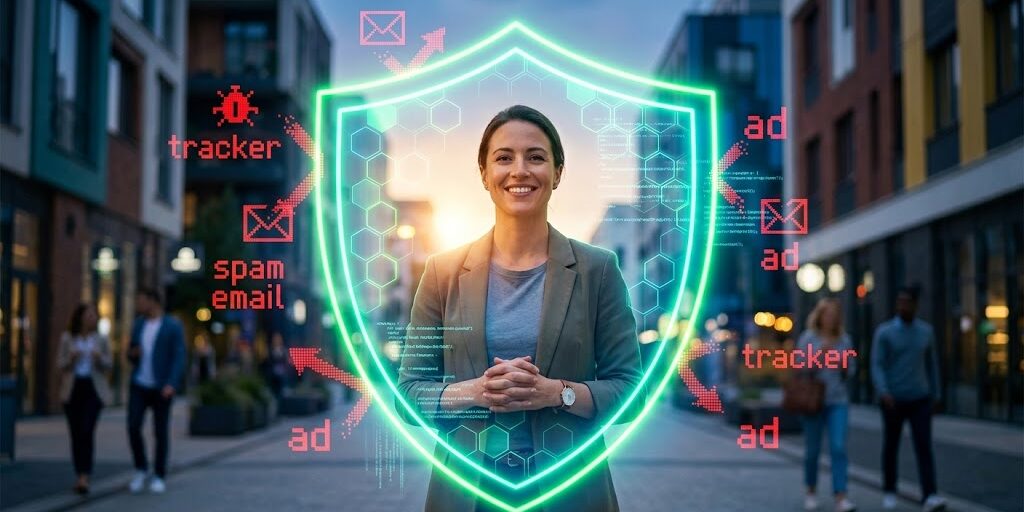
This is entirely backward. Privacy is not about hiding bad things. Privacy is the invisible shield that allows us to be our weird, wonderful, authentic selves. Privacy is the freedom to sing in the shower without an audience. Privacy is what makes human life fun, relaxing, and awesome.
In this massive, deep-dive guide, we are going to explore exactly why privacy is the greatest superpower of the 21st century. Along the way, you will find 10 Interactive Widgets to prove exactly how this invisible superpower works, how you are losing it, and how you can take it back today.
1. The Awesome Freedom of Being Unobserved
There is a famous concept in psychology and architecture called the “Panopticon.” Invented by a man named Jeremy Bentham in the 1700s, it was a design for a prison. In this prison, the guards sat in a dark tower in the center, and the prisoners were in brightly lit cells in a circle around them.
The trick of the Panopticon was this: the prisoners could never see inside the tower. They never knew if the guard was looking at them, or if the guard was asleep, or if the guard was even there at all. Because they might be watched at any second, they started policing themselves. They stopped acting naturally. They became rigid and terrified.
The internet today is a giant digital Panopticon. When you know that Google, Facebook, and hundreds of invisible data brokers are watching your every click, your behavior changes. You stop asking “dumb” questions on search engines. You stop researching weird hobbies. You become a rigid, boring version of yourself.
When you reclaim your privacy, you destroy the guard tower. You get to be curious again. You get to search for “how to fix a toilet” or “why do penguins waddle” without worrying that an advertiser is going to follow you for three weeks trying to sell you plumbing supplies and bird seed.
2. The Awesome Power of Financial Fairness
Let’s move from feelings to hard cash. Privacy is incredibly awesome because it saves you money. A lot of money.
Have you ever heard of “Dynamic Pricing” or “Price Discrimination”? This is a sneaky tactic used by airlines, hotels, and massive online stores. Because these companies track you across the internet using cookies, they know a terrifying amount about your wallet.
Imagine a woman named Sarah. Sarah is planning a trip to a wedding. On Monday, she searches for flights to Chicago. The flight is $300. She decides to think about it. On Tuesday, she searches again. The airline’s website checks her cookies. It says, “Ah, Sarah is back. She searched for this yesterday. She must really need to go to Chicago. She is getting desperate.”
Magically, the price of the flight jumps to $450. The airline did not run out of seats. The airplane fuel did not suddenly get more expensive. The airline simply used Sarah’s tracking data against her. They weaponized her browsing history to squeeze an extra $150 out of her pocket.
When you have digital privacy—when you block trackers and regularly clear your data—you become a ghost. The airline doesn’t know you are desperate. They just see a brand new, anonymous customer. You get the fairest, lowest price. Privacy puts the negotiating power back in your hands.
3. The Joy of Not Being Followed by Creepy Ads
We have all experienced the “Stalker Ad.” You look at a blender on a shopping website on Monday. You don’t buy it. But for the next month, that exact same blender follows you everywhere. It shows up on your Facebook feed. It shows up while you are reading the news. It shows up in the margins of a recipe website.
It feels like someone is standing right behind your shoulder, constantly whispering, “Hey… remember the blender? Buy the blender. Buy it.”
This happens because of third-party cookies and tracking pixels. These tiny pieces of code allow advertisers to build a highly specific profile of your desires. It is incredibly annoying, and it ruins the relaxing experience of browsing the web.
When privacy is awesome, the web is quiet. When you block trackers, you get to explore the internet without leaving a breadcrumb trail. You can look at a pair of shoes, close the window, and never think about them again. Taking back your privacy is like hiring a digital bouncer who stands at the door of your browser and says “No” to the creepy salesmen trying to follow you inside.
4. The Power to Protect Your Relationships
Privacy is the glue that holds our human relationships together. Think about it: you do not talk to your boss the same way you talk to your spouse. You do not share the same jokes with your grandmother that you share with your best friend from college.
We naturally create different “zones” of privacy in the real world. This is healthy. It allows us to be professional at work and goofy at home.
But the internet—specifically social media and data brokers—wants to destroy these zones. They want to crush all your different lives into one giant, public folder. When data brokers collect your home address, your job title, your political donations, and your family members, they are ripping down the walls between your zones.
Privacy is awesome because it gives you the power to choose who knows what. You get to decide who sees your vacation photos. You get to decide who knows your phone number. You are the director of your own life, not a product on a shelf waiting to be analyzed by an algorithm.
This is precisely why keeping your family’s digital privacy safe is an act of love. You are protecting their right to have private zones.
5. The Peace of a Silent Inbox
Do you remember when it was exciting to get an email? Or when your phone rang, and you actually looked forward to picking it up because it was probably a friend?
Today, our phones are stress machines. We get texts about fake Amazon packages. We get emails from fake Nigerian princes. We get robocalls about our car’s extended warranty five times a day. We ignore our ringing phones because we assume it is a scammer.
How did the scammers get your phone number? How did they get your email address? They bought it. Data brokers scrape this information from public records, sweepstakes forms, and old accounts. Then they sell massive lists of contact information to spam networks for pennies.
Privacy is awesome because it restores the peace and quiet of your digital life. When you actively practice data hygiene—when you use strong spam filters, create burner email addresses, and aggressively use services like Wiperts to rip your phone number out of data broker databases—the noise stops. Your phone goes back to being a tool for you to talk to your family, not a billboard for scammers to yell at you.
6. Passwords: The Magical Keys to Your Castle
Let’s talk about something most people hate: passwords. We have to remember dozens of them. Every website has different rules. “You must include a capital letter, a number, a symbol, and the blood of a unicorn.” It is exhausting.
But if you change your mindset, passwords become awesome. A password is the only thing standing between a criminal in a basement halfway across the world and your life savings. That tiny string of letters is a magical, unbreakable lock on the door of your digital castle.
When you start using a Password Manager (a secure app that remembers all your passwords for you), you gain an incredible superpower. You can generate passwords that look like `Xq$9!vB2z^Lp`. You never have to remember them. Hackers cannot guess them. You get to sleep soundly at night knowing that your digital doors are made of titanium.
7. App Permissions: Becoming the Boss of Your Phone
Your smartphone is a miracle of technology. It has a high-definition camera, a hyper-sensitive microphone, and a GPS unit that communicates with satellites in space. It is incredible.
But when you download a simple “Flashlight” app or a free “Sudoku” game, and that app asks for permission to use your camera and your GPS, the miracle turns into a nightmare. Why does a flashlight need to know what street you are walking on? Why does a puzzle game need to listen to your microphone?
They don’t. They ask for these permissions so they can harvest your data in the background and sell it. You are carrying a spy device in your pocket.
Taking back your privacy is awesome because it makes you the absolute boss of your phone again. When you open your settings and shut off the microphone access for 90% of your apps, you instantly blind the spies. You take a device that was working for data brokers and force it to work only for you.
8. Beating the “Terms of Service” Trap
Every time you sign up for a new website, a massive box of tiny text appears. It is the “Terms of Service” (TOS). At the bottom is a shiny blue button that says “I Agree.”
You click the button. Everyone clicks the button. It is a known fact that nobody reads the Terms of Service. Why? Because lawyers write them to be incredibly boring, confusing, and long. It is a trap designed to make you give up your rights without a fight. By clicking “I Agree,” you are often legally agreeing to let them sell your data, track your location, and use your photos.
Privacy is awesome because it teaches you how to step out of the trap. You don’t have to become a lawyer. You just have to realize that your data is the currency. If an app’s Terms of Service demand too much of your currency (your privacy) for a service that isn’t worth it, you have the awesome power to walk away and say, “No thanks, keep your app.”
9. The Freedom of a Blank Slate
There is a beautiful concept on the internet known as the “Right to be Forgotten.” In Europe, this is actually a strict law. It means that humans make mistakes. We grow up. We change. We should not have our entire past held against us on page one of Google for the rest of our lives.
In America, we do not have this strict law yet. Because of data brokers, your past mistakes, old addresses, and embarrassing old internet accounts are permanently stamped into your digital footprint. It is like dragging a heavy anchor of data behind you everywhere you go.
Privacy is awesome because it allows you to cut the rope to that anchor. When you actively work to delete your old accounts, when you remove yourself from people-search directories, and when you scrub your digital footprint, you get to start over. You get a blank slate. You get to define who you are *today*, not who you were ten years ago.
10. Defeating the Data Brokers (The Ultimate Superpower)
We have talked about blocking ads, changing passwords, and ignoring scammers. But the most powerful privacy move you can make—the absolute pinnacle of digital freedom—is taking the fight directly to the Data Brokers.
Data brokers (like Spokeo, Whitepages, and Intelius) are the villains of the internet. They scrape your public records, package them up with your web tracking history, and sell your life as a product. They are the reason you have the “Heavy Anchor” we just talked about.
By law, you have the right to demand that these companies delete your files. This is called “Opting Out.” But the data brokers hate it when you opt-out. If they delete your file, they lose money. So, they make the opt-out process as painful, confusing, and frustrating as humanly possible.
The Whack-A-Mole Problem
If you try to delete your data yourself, you will quickly discover the “Whack-A-Mole” problem. You might spend five hours on a Saturday filling out confusing forms to get your home address off of three websites. You feel victorious.
But two months later, the data brokers just scrape a new public record and put your address right back up. The mole pops back out of the hole. You have to start all over again. It is designed to exhaust you so that you give up.
But you don’t have to give up. The true awesome power of privacy is realized when you hire professionals to wield the hammer for you. This is why services like Wiperts exist. We use automated software and legal experts to slam the hammer down on the data brokers, forcing them to delete your files, and constantly monitoring the web to make sure the moles never pop back up.
Conclusion: Reclaim Your Superpower
Privacy is not dead. It is not an old-fashioned idea. Privacy is the modern shield that protects your money from dynamic pricing, your phone from scammers, and your family from stalkers.
It allows you to explore the world without being tracked, to share your life only with the people you love, and to sing in the digital shower without an audience.
Stop settling for the Panopticon. Turn off those creepy app permissions, start using strong passwords, and stop letting data brokers treat your life like a product on a shelf.
Taking back your privacy is the most awesome, empowering thing you can do for yourself today. And you don’t have to do it alone.
Ready to activate your superpower?
Don’t play Whack-A-Mole with data brokers. Wiperts finds and removes your personal information from the internet automatically. Regain your freedom today.
Protect My Identity Now